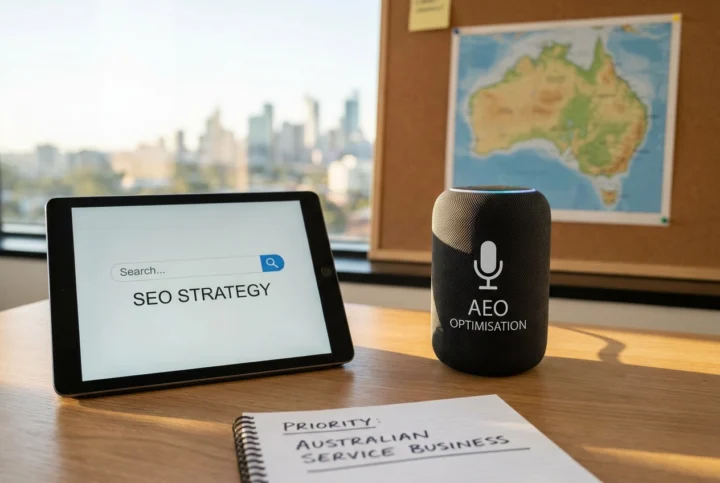
Something has quietly changed about how your next client finds you. They are no longer just typing keywords into Google and scanning a list of blue links. Increasingly, they are asking an AI a direct question and acting on whatever answer comes back. That shift is why the conversation around answer engine optimisation has moved from niche curiosity to genuine business priority in 2025 and 2026.
But here is where most advice goes wrong. AEO is being sold as a replacement for SEO, when the reality for Australian service businesses is far more nuanced. These two disciplines serve different discovery moments, share roughly 70% of the same technical foundations, and work best when sequenced rather than swapped.
This post maps exactly where SEO and AEO overlap, where they diverge, and how to allocate your budget intelligently across both. You will learn what each discipline actually does for a service business, why AEO without established SEO authority is essentially invisible, and how to build a practical, sequenced approach whether you run a trade business, a professional services firm, or a local consultancy.
What SEO Does for Service Businesses
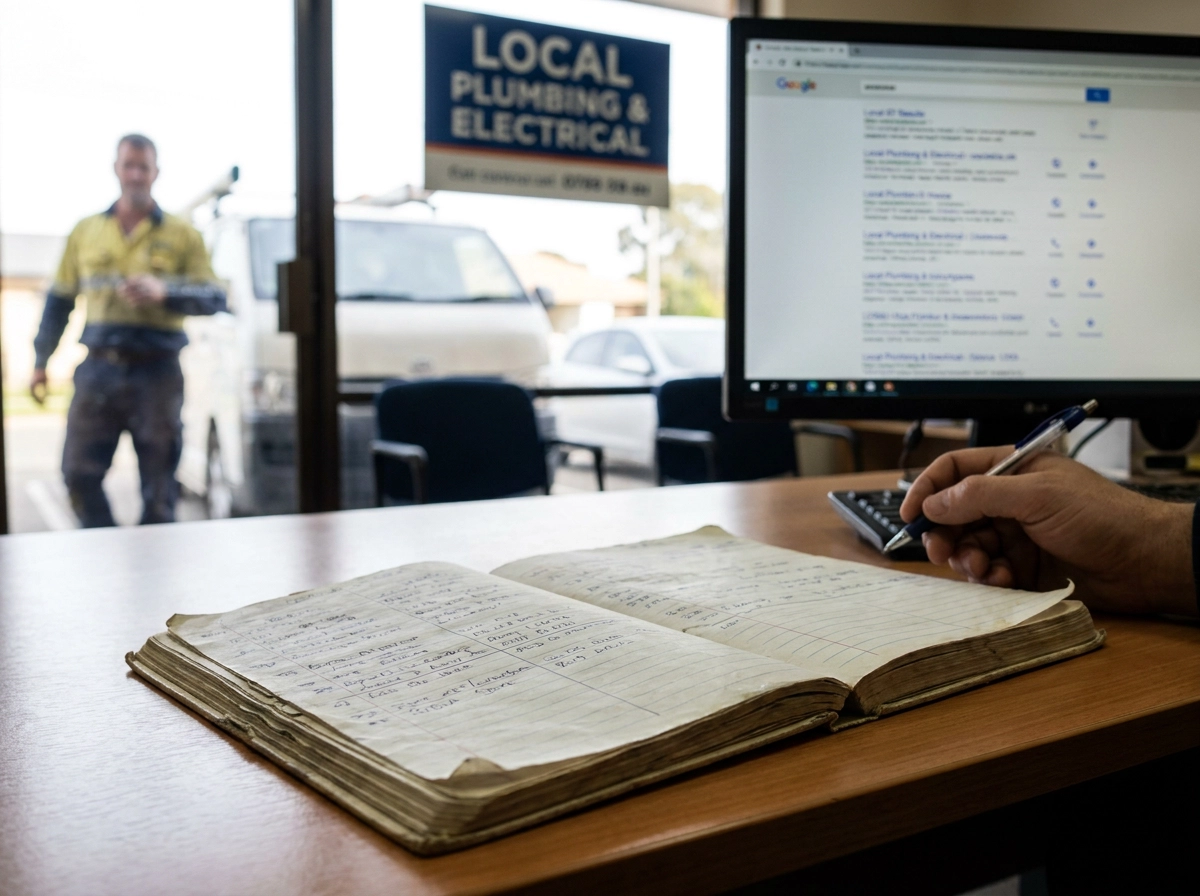
SEO optimises your website to appear in Google’s traditional ranked results. The unit of success is a click through to your site from one of those positions, and for most Australian service businesses, that click remains the primary source of measurable inbound enquiries.
Classic organic search still accounts for an estimated 60–80% of inbound traffic for Australian service businesses, making it the dominant discovery channel even as AI tools reshape how some users search. Google holds 90.04% global search market share as of January 2026, the lowest figure in over 20 years, yet still dominant enough that any business walking away from SEO prematurely is making a costly mistake.
The core levers are straightforward: keyword targeting to align your pages with what prospects are actively searching; on-page content that matches search intent clearly; technical site health covering page speed, crawlability, and mobile usability; and earned backlinks that signal credibility to Google’s ranking systems. Understanding what a competent SEO agency actually delivers in 2026 means recognising that these fundamentals have not changed, even if the competitive environment around them has.
For service businesses specifically, local SEO signals carry the most direct weight. A complete and accurate Google Business Profile, consistent name, address, and phone details across directories (NAP consistency), local citations from relevant Australian directories, and geo-targeted service pages together form the bedrock of enquiry-generating visibility. A tradie or consultant without these in order is leaving high-intent, ready-to-buy traffic on the table regardless of how polished the rest of their site is.
Knowing what an SEO company should actually do in 2026 starts here, with these fundamentals confirmed and performing, before any additional visibility layer is worth building on top.
What Answer Engine Optimisation (AEO) Does Differently
Where SEO wins clicks from ranked results, answer engine optimisation (AEO) targets something different entirely: a citation inside an AI-generated summary. The unit of success is not a visit to your website; it is your business being named as part of the answer before a prospect ever decides which site to open.
The scale of that opportunity is significant. Google AI Overviews now reach 1.5 billion users monthly across more than 200 countries, and that figure surpassed 2 billion by mid-2025. Each summary draws from a narrow pool of just 2 to 7 domains per answer, compared with 10 organic positions in a classic SERP. Fewer slots means the competitive stakes per citation are substantially higher.
AEO extends beyond Google. ChatGPT, Perplexity, and Gemini are now the first stop for users asking comparative queries such as “best bookkeeper for a small business in Melbourne” or “top structural engineer in Brisbane.” On those platforms, citation is visibility; there is no ranking position to fall back on.
The commercial case for pursuing those citations is strong. Visits originating from AI search convert approximately 4.4 times better than classic organic traffic, according to a Semrush study from June 2025 covering more than 500 topics. A single consistent AI citation can therefore carry more commercial weight than a mid-page organic ranking.
The role of an SEO consultant working across rankings, AI Overviews, and answer engines has expanded precisely because of this shift. SEO gets prospects to your website; AEO makes your business part of the answer before the decision to visit any website has formed, which matters most in professional services where AI-comparative queries are accelerating fastest.
Where SEO and AEO Share the Same Foundation
Despite serving different discovery moments, SEO and AEO share roughly 70% of their underlying work. High-quality content, clean HTML structure, structured data markup, fast page load times, and earned backlinks all serve both channels simultaneously. This overlap is the budget case for a sequenced approach: every dollar you spend fixing technical SEO contributes directly to AEO readiness, so the investment compounds rather than duplicates.
Technical foundations pay twice. Resolving crawl errors, meeting Core Web Vitals thresholds, and implementing schema are not SEO-only tasks. AI engines parse the same clean, fast, well-structured pages that Google ranks. A service business that fixes its technical foundations is not doing pre-work before AEO; it is building the shared infrastructure both channels require.
Content quality is the clearest shared signal. Fact-dense, well-structured content correlates with over 40% AI visibility increase (Princeton study). The same attributes that earn a Google ranking, specific claims, logical structure, genuine expertise, are the attributes AI engines select when composing an answer. Thin content fails in both channels for the same underlying reason.
Structured data signals both systems. FAQ schema, HowTo schema, and LocalBusiness schema tell Google’s ranking systems and AI engines what your content is about and what kind of entity you are. Understanding how these schemas interact with both traditional rankings and AI citation is one of the sharper edges separating agencies built for AI-era search from those still operating on older models.
Backlinks serve both, through different mechanisms. For SEO, they convey ranking authority. For AEO, they contribute to entity corroboration, the process by which AI models confirm a business is a credible, real-world entity worth citing. The signal differs in function, but the source is identical: earning links from relevant, authoritative sites.
Where AEO Diverges: The 30% That Is Unique to Answer Engines
The shared 70% foundation gets you indexed and ranked. What follows is the territory that SEO alone cannot cover.
Entity clarity has no SEO equivalent. AI engines must resolve unambiguously who your business is, what service category it belongs to, and where it operates before they will cite it. That resolution depends on consistent schema markup, a Wikidata presence, and uniform NAP details across Australian directories and industry body listings. A plumber listed differently across five directories creates entity ambiguity that AI engines resolve by ignoring you entirely.
Third-party corroboration is the most underestimated lever in the whole stack. Independent citations of your business, across review platforms, industry associations, and editorial mentions, correlate with AI visibility approximately 3x more strongly than links alone. This is a meaningfully different mechanism from link building. A mention in an industry body directory or a local business journal carries weight that a backlink from the same source does not fully replicate.
Prompt-aware content means restructuring service pages and FAQs to answer the conversational queries users type into ChatGPT or Perplexity directly. “What does a conveyancer do in Queensland?” is not a keyword. It is a prompt. Pages optimised only for keyword phrases miss this query class entirely.
Freshness signals operate differently here too. For time-sensitive queries, AI models weight recency when selecting sources, which means a publish-and-leave approach loses ground progressively. A regular content refresh cadence is an AEO requirement, not a nice-to-have.
Collectively, these tactics are what practitioners call GEO (Generative Engine Optimisation), a discipline that sits within this 30% and targets citation by ChatGPT, Perplexity, Gemini, and Google AI Overviews specifically. It has no direct counterpart in traditional SEO services as they were practised even three years ago. The unit of success is a mention, not a position.
The Critical Trap: Why AEO Without SEO Authority Fails
Those AEO-specific tactics only pay off if AI engines already consider your business a credible source. That credibility is not built through AEO work alone.
AI engines do not independently discover unknown businesses. They cite sources that have already established authority through indexed content, earned backlinks, and third-party mentions; the same signals that determine SEO rankings. There is no separate discovery pathway for AI citation.
The consequence is blunt: a service business sitting on page 5 with thin content and no backlinks will not appear in AI Overviews or LLM answers, regardless of how well its pages are structured for conversational queries. Authority is the entry requirement, not an optional upgrade.
The competitive pressure compounds this. That narrower citation pool, just 2 to 7 domains, creates winner-takes-most dynamics. Businesses with the strongest existing authority signals capture the available citation slots. Early SEO investment becomes a compounding asset because it builds the authority that later determines AI citation eligibility.
Meanwhile, AI Overviews have already dropped organic click-through rates by 19 to 35 per cent (Seer Interactive, September 2025, over 3,000 domains). Businesses with established rankings but no AEO readiness are losing traffic from positions they earned without gaining citation visibility in return. That is a losing position on both channels simultaneously.
The practical implication is straightforward. Investing budget in AEO tactics before SEO fundamentals are solid is optimising for a prize that requires authority you have not yet earned. Before considering which AEO signals to build, it is worth understanding what to actually look for in local SEO companies so the authority foundation is built on work that genuinely compounds.
How to Prioritise Your Budget: A Sequenced Approach for Service Businesses
Knowing the sequence matters is one thing. Having a concrete 90-day plan to execute it is another.
Phase 1 (Days 1-30): Fix SEO fundamentals. Run a technical audit and resolve crawl errors, page speed issues, and mobile usability failures. Implement LocalBusiness and FAQ schema on your site. Ensure your Google Business Profile is verified, complete, and accurate, Google’s own guidance confirms businesses with complete information are materially more likely to appear in local results. Nothing AEO-specific belongs in this phase.
Phase 2 (Days 31-60): Layer AEO signals. Build entity clarity by standardising your business name, address, and phone number across Australian directories and relevant industry body listings. Pursue third-party citations from editorial sources and review platforms, these third-party corroboration signals carry the outsized AI citation weight described above. Restructure key service pages to directly answer the conversational queries prospects type into ChatGPT and Perplexity, not just the keywords they type into Google.
Phase 3 (Days 61-90): Track prompt visibility. Use tools such as Otterly.AI or Profound to monitor where your business appears in AI-generated answers. Identify citation gaps, then adjust content freshness and entity signals based on what the engines are actually surfacing.
Budget framing: A functional dual-stack covering both traditional SEO tools and AEO visibility tracking starts from approximately AUD $55/month, scaling to AUD $200-350/month for a growth stack across both channels. Tool costs are secondary to getting the sequence right.
This is not about doing SEO indefinitely before touching AEO. It is about building an authority foundation solid enough that AEO investment has something to amplify.
What This Means for Trades, Professional Services, and Local Consultancies
That sequencing framework applies differently depending on your business type, and understanding the distinction shapes where you focus first.
Professional services firms face the sharpest exposure. When a prospect types “best structural engineer in Brisbane” or “top bookkeeper for small business” into an AI tool, citation determines whether your firm is considered at all. With AI engines citing only a handful of domains per answer, a weak authority footprint means total invisibility at the decision moment.
Trades operators are often closer to AEO readiness than they realise. A plumber or electrician with a well-maintained Google Business Profile, consistent listings across True Local, Yellow Pages, and industry directories, and a steady stream of reviews has already built the entity corroboration layer that AEO requires. Those citations signal to AI engines that your business is a legitimate, geographically established entity. The gap between current state and AEO-ready is frequently smaller for trades than for professional services firms starting from a thin online footprint.
Tool adoption is accelerating, but strategy is not. Awareness of GEO and AEO is growing among Australian service businesses in 2026, but most are yet to act on a coherent strategy. The competitive advantage comes from correct sequencing, not the most subscriptions. A dashboard showing AI citation gaps is useless without the authority foundation to act on what it reveals.
For any service business currently investing in SEO, the practical question is narrow: are your fundamentals solid? If yes, extending that investment to cover the 30% of AEO work not already addressed is the logical next step, not a budget reallocation. If you are uncertain whether your SEO foundation is strong enough, the criteria covered in what experienced buyers look for when choosing an SEO agency in Perth apply equally here: prioritise execution quality over tool count.
The Practical Verdict for Australian Service Businesses
The strategic conclusion is straightforward: SEO and AEO are sequential layers of the same investment, not competing budget lines. Because roughly 70% of the underlying work overlaps, sequencing them correctly multiplies returns rather than duplicating spend.
Start with SEO fundamentals. Clean technical foundations, accurate local signals, and authoritative content are the prerequisites that make AEO productive. Without them, AEO investment has no authority to amplify.
Layer AEO signals once that foundation is solid. Entity clarity, third-party corroboration, and prompt-aware content represent the 30% that determines whether AI engines mention your business when prospects are deciding who to contact. That 30% is largely wasted if the underlying authority is not already there.
The commercial case for getting the sequence right is concrete. As established earlier, AI search visits convert at 4.4x the rate of classic organic traffic, so even a handful of citations carries material revenue weight. With AI Overviews at 1.5 billion monthly users and only 2–7 citation slots per answer, early authority matters. The businesses that establish citation authority early will hold those slots as AI-driven discovery scales.
The right question is never AEO or SEO. It is whether your current SEO foundation is strong enough to support AEO. If technical issues remain unresolved, local signals are inconsistent, or content lacks genuine authority, fix those first. If the fundamentals are solid, the 30% of AEO-specific work is where your next investment belongs.
Most Australian service businesses are closer to AEO readiness than they realise. The gap is usually sequencing, not starting over.
Conclusion
SEO and AEO are not competing strategies; they are sequential ones. The sequence, SEO foundations first, AEO signals second, is what turns both channels into compounding assets.
For trades, professional services, and local consultancies across Australia, the opportunity is real and the window is open. AI-driven discovery is scaling fast, and the businesses cited early will be hardest to displace.
The practical next step is simple: audit your current SEO foundations honestly. Identify the gaps, fix them in sequence, then layer AEO signals on top of genuine authority.
Frequently Asked Questions
What is the main difference between SEO and AEO for Australian service businesses?
SEO optimises your website to appear in Google's ranked results, where success is measured by clicks through to your site. AEO (Answer Engine Optimisation) targets citations within AI-generated summaries on platforms like ChatGPT and Google AI Overviews, where success is being named as part of the answer before prospects visit any website. While SEO accounts for 60-80% of inbound traffic for most Australian service businesses, AEO visits convert 4.4x better than classic organic traffic.
Should I replace SEO with AEO in 2025?
No. SEO and AEO are sequential layers, not competing strategies. Approximately 70% of the underlying work overlaps between both disciplines, including technical foundations, content quality, structured data, and backlinks. The correct approach is to fix your SEO fundamentals first, then layer AEO signals on top. Investing in AEO without established SEO authority is essentially invisible because AI engines only cite sources that have already built credibility through indexed content, earned backlinks, and third-party mentions.
What are the key AEO-specific tactics that differ from traditional SEO?
The 30% of AEO work unique to answer engines includes: entity clarity (consistent schema markup and NAP details across directories), third-party corroboration (independent citations across review platforms and industry associations that correlate 3x more strongly with AI visibility than links alone), prompt-aware content (restructuring pages to answer conversational queries like 'best bookkeeper for small business in Melbourne'), and freshness signals (regular content updates that AI models weight for time-sensitive queries).
How should I allocate my budget across SEO and AEO?
Follow a 90-day sequenced approach: Phase 1 (Days 1-30) focuses on SEO fundamentals—fix technical issues, implement schema, and ensure your Google Business Profile is complete. Phase 2 (Days 31-60) layers AEO signals—standardise NAP across directories, build third-party citations, and restructure pages for conversational queries. Phase 3 (Days 61-90) involves tracking AI visibility and adjusting based on results. A functional dual-stack starts from approximately AUD $55/month, scaling to AUD $200-350/month for growth. The key is getting the sequence right rather than spending the most on tools.
Why are trades operators often closer to AEO readiness than professional services firms?
Trades operators with well-maintained Google Business Profiles, consistent listings across True Local and Yellow Pages, and steady review streams have already built the entity corroboration layer that AEO requires. These citations signal to AI engines that the business is legitimate and geographically established. Professional services firms often start with thinner online footprints and face sharper exposure when prospects search AI tools for comparative queries like 'best structural engineer in Brisbane,' where citation determines visibility. For trades, the gap to AEO-ready status is typically smaller than for professional services starting from a weak authority foundation.